


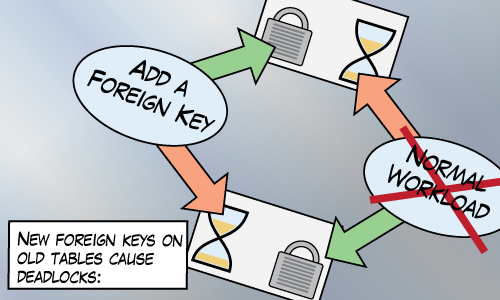
Takeaway: Adding foreign keys require schema modification locks on every table involved. This can cause deadlocks on busy systems.
Schema modification locks (SCH-M) are taken by DDL (Data Definition Language) statements like CREATE/ALTER/DROP.
Schema stability locks (SCH-S) are taken by DML (Data Manipulation Language) statements like INSERT/UPDATE/DELETE.
Those two types of locks are incompatible. Meaning, I can’t get a SCH-S lock on some table if you’ve already got a SCH-M lock on it (and vice versa).
Paul Randal describes the SCH-M lock as a super-table-X lock. It makes sense to me, if I’m half way through querying a table, I don’t want its definition to change.
Such a pessimistic lock can be awkward for a busy system. The SCH-M can cause a lot of blocking. For example, creating (and dropping) foreign keys requires a SCH-M lock not only on the parent table, but also on the referenced table which leads to trouble.
Our Environment
Our environment is busy. We support thousands of databases that run 24-7 and we don’t really have time for any maintenance windows. So we really value changes that are as ONLINE as possible.
In the past few years, we’ve noticed occasional problems with the creation of foreign keys. These problems would take the form of deadlocks or excessive blocking, timeouts in the application, and website errors seen by end users.
As we grow in size, and make more changes to our databases, these problems became more frequent and more annoying. We see so much variety and volume of queries that it’s a bit like Murphy’s law. If some sort of race condition can cause trouble, then it will cause trouble. Maybe you can relate.
I explore two specific scenarios we’ve had trouble with. These scenarios seem safe but I’ll describe how they can go wrong, and what we do about them.
Creating a table with more than one foreign key
Creating a new table with more than one foreign key leads to trouble. There’s no concurrency issue with the new table because no one else knows it exists yet. It’s the other two SCH-M locks.
Trouble:
CREATE TABLE dbo.BrandNewTable ( Id BIGINT IDENTITY NOT NULL PRIMARY KEY, FirstId BIGINT NOT NULL CONSTRAINT FK_BrandNewTable1 FOREIGN KEY (FirstId) REFERENCES dbo.First(Id), SecondId BIGINT NOT NULL CONSTRAINT FK_BrandNewTable2 FOREIGN KEY (SecondId) REFERENCES dbo.Second(Id) ); |
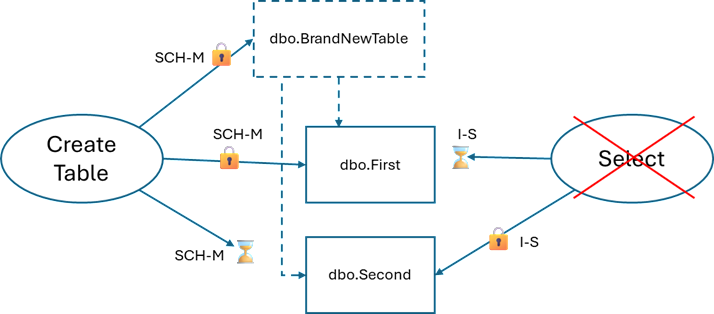
The SCH-M lock on BrandNewTable doesn’t even matter here. It’s the SCH-M locks on the other tables. Grabbing a SCH-M locks on dbo.First and then dbo.Second may deadlock with queries that want to use dbo.Second and then dbo.First.
I have this picture in my head when I think about this kind of deadlock:
Better:
This one’s easy to avoid, just add the foreign keys in separate statements (not in a transaction!):
CREATE TABLE dbo.BrandNewTable ( Id BIGINT IDENTITY NOT NULL PRIMARY KEY, FirstId BIGINT NOT NULL, SecondId BIGINT NOT NULL ); ALTER TABLE dbo.BrandNewTable ADD CONSTRAINT FK_BrandNewTable1 FOREIGN KEY (FirstId) REFERENCES dbo.First(Id); ALTER TABLE dbo.BrandNewTable ADD CONSTRAINT FK_BrandNewTable2 FOREIGN KEY (SecondId) REFERENCES dbo.Second(Id); |
Creating a foreign key between two existing tables
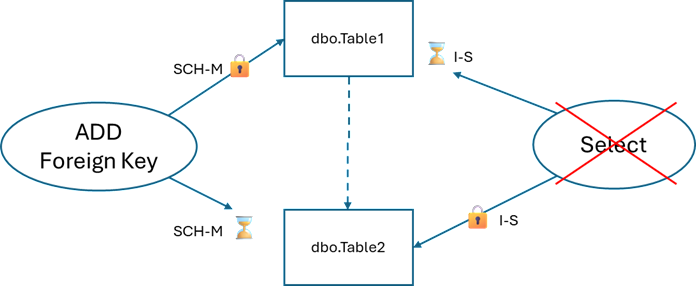
When creating a foreign key, SQL Server needs to take SCH-M locks on two tables inside a single transaction. If those tables are being queried, we can see contention.
Trouble
ALTER TABLE dbo.Table1 WITH NOCHECK ADD CONSTRAINT FK_Table1_Table2 FOREIGN KEY (Table2Id) REFERENCES dbo.Table2(Id); |
We get another deadlock similar to the first:
Maybe Better:
This one is harder to avoid but I’ve had some success with writing a script that retries deadlocks. I’m basically listening to the error message: “you have been chosen as the deadlock victim. Rerun your transaction”
SET DEADLOCK_PRIORITY LOW; DECLARE @MaxRetryCount INT = 20; DECLARE @RetryCount INT = 0; WHILE @RetryCount <= @MaxRetryCount BEGIN BEGIN TRY ALTER TABLE dbo.Table1 WITH NOCHECK ADD CONSTRAINT FK_Table1_Table2 FOREIGN KEY (Table2Id) REFERENCES dbo.Table2(Id); BREAK; END TRY BEGIN CATCH SET @RetryCount = @RetryCount + 1; WAITFOR DELAY '00:00:03'; END CATCH END; |
Advice
If you’re making changes to busy environments
- Don’t add more than one foreign key inside a
CREATE TABLEstatement. - Update: Kevin Feasel points out that ideally, and when possible, “apply foreign key constraints at table creation time.”
- If your deployment process is manual or resilient at all, consider taking one for the team.
SET DEADLOCK_PRIORITY LOWbefore executing DDL statements. This way you’re volunteering to be the deadlock victim and you can retry. - If your workload consists of long-running queries, then schema modifications will block any new query executions until the in-progress queries complete. But that’s a topic for another day.
- If you want to reproduce this yourself, I added code in the comments.
